

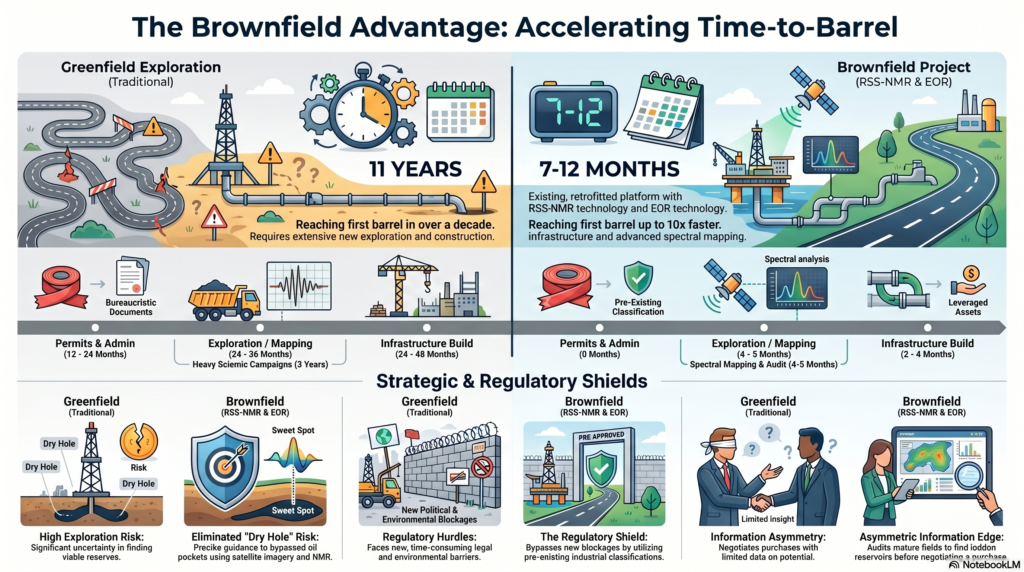
Introduction: The Brownfield Renaissance through RSS-NMR Technology
Faced with the increasing maturity of global sedimentary basins, the oil and gas industry finds itself at a crossroads between exploring new and complex frontiers ((greenfields ) and optimizing existing assets (brownfields). In this context of economic rationalization and transition, Nuclear Magnetic Resonance Remote Sensing ( RSS -NMR) technology is emerging as a disruptive strategic lever. Far from simply being declining fields, brownfields hold significant optimization potential that RSS-NMR unlocks in two crucial steps.
1. Revealing the Invisible: Identifying Unseen Reservoirs ( Bypassed Pay )
brownfield revitalization lies in tracking down hydrocarbon volumes bypassed or missed by initial exploration campaigns. Conventional seismic methods and historical well logs sometimes leave blind spots, mistaking thin or complex reservoirs for barren layers. RSS-NMR, thanks to its unique direct fluid detection capability and high spectral resolution, acts like a precision scanner. It allows for the certain identification of these ” sweet spots” and undrilled reservoir compartments, instantly transforming areas deemed marginal into immediate production opportunities, without the financial risk associated with “drilling to see.”
2. Anticipate and map: Preparing for assisted recovery (EOR)
Enhanced recovery campaigns. Oil Recovery (EOR). The success of EOR (whether using gas injection, polymers, or thermal methods) depends entirely on the precise knowledge of residual oil saturation ( Sor ) and pore connectivity. By providing advanced remote fluid-matrix characterization, RSS-NMR enables the modeling of fluid movements with unprecedented scientific rigor. It thus secures the massive investments associated with EOR by maximizing the final recovery factor.
3. The Strategic Choice: Brownfield vs Greenfield
The redevelopment of Brownfields using cutting-edge technologies such as RSS-NMR structurally surpasses the opening of new Greenfield projects on three fundamental pillars:
1- From a regulatory and environmental perspective: The current legislative framework imposes drastic constraints and increasingly long permitting processes for brownfield sites (environmental impact assessments, public consultations, decarbonization standards). Reinvesting in a brownfield allows companies to capitalize on existing permits and achieve a significantly lower carbon footprint per barrel produced, perfectly aligning with the sustainability criteria required by regulators and investors.
2- In terms of time -to-market : While a greenfield project often requires a decade between discovery and the first barrel (studies, heavy engineering, pipeline installation), a brownfield project already has operational surface infrastructure (platforms , gathering networks, terminals). The integration of new discoveries via RSS-NMR results in an ultra-short production cycle, measured in months rather than years.
3-From a financial perspective: The initial capital expenditure ( CAPEX ) of a greenfield project is enormous and subject to long-term market fluctuations. Conversely, redeveloping a mature field optimizes already amortized infrastructure. The use of RSS-NMR drastically reduces geological risk and the dry-well rate, guaranteeing a rapid return on investment ( ROI ), minimal development cost per barrel, and resilient profitability, even during periods of price volatility.